If you're reading this, you may be facing the worst week of your life. We're sorry. There is nothing about this you should have to figure out alone, and the room where it happened is one of the things you can hand to someone else. Our technicians come in, close the door behind them, and do the work so that you, your children and your relatives don't have to see it or carry that image forward.
We approach these homes knowing that a family will live there again, or will walk through it one last time before a sale. That shapes how we work. We move slowly around personal belongings, keep conversations private, and explain what we found and what we did in calm, plain terms if you want to know. If you'd rather not hear details, that's fine too. You can simply tell us when you're ready for the room to be yours again.
When families call us for suicide cleanup
The scene has been released
Police and the Medical Examiner's Office have finished their work and the home is back in your care.
A relative feels they must clean
Someone in the family is about to start cleaning, and you want to spare them that.
The room is in a rental
A tenant died and the landlord needs the unit decontaminated with respect for the family.
It happened in a car or garage
Vehicles and garages need the same careful work, including seats, carpet and bare concrete.
Belongings need recovering
Documents, a phone or keepsakes in the room are needed by the family soon.
You want help with insurance
You'd like someone who can speak with the adjuster and supply the documentation.
Why family members should not clean up after a suicide
Many relatives feel they should do it themselves, out of love or a wish to protect privacy. We gently ask you not to. The physical risk is real: blood can carry bloodborne pathogens, and cleaning it safely calls for gloves, eye protection, respirators and disposal methods most homes don't have. Household bleach can discolor a surface without disinfecting what has soaked in below it.
The emotional cost is heavier still. Cleaning the place where someone you love died can fix that scene in memory in a way that is hard to undo. Friends who offer to help can be affected too. It's also easy to miss contamination behind furniture, under rugs or in the gaps of a wood floor, which means the room may never quite feel clean. Letting trained technicians take over isn't giving up responsibility. It's a way of protecting the people who are left.
If a well-meaning relative has already started, that's all right. Ask them to stop where they are and set the supplies aside, and we'll finish from there.
What happens after you call us for suicide cleanup
A calm first call
We answer 24/7. We ask only what we need: the address, who can authorize the work, and whether the home has been released.
A private walkthrough
A technician meets you or your representative, looks at the affected area and explains the plan. You can stay outside if you prefer.
Recovery of personal items
We set aside belongings, clean what can be cleaned, and note anything that can't be saved before it is removed.
Removal and disinfection
Contaminated materials are removed and sealed in red biohazard bags. Remaining surfaces get hospital-grade disinfectant left wet for the full dwell time.
Testing and odor control
ATP swabs confirm surfaces are clean, and air scrubbing and deodorizing clear any lingering smell.
A gentle handover
We take waste to a permitted facility, return the room ready to use, and give you or your adjuster the paperwork.
How we keep the work quiet and private
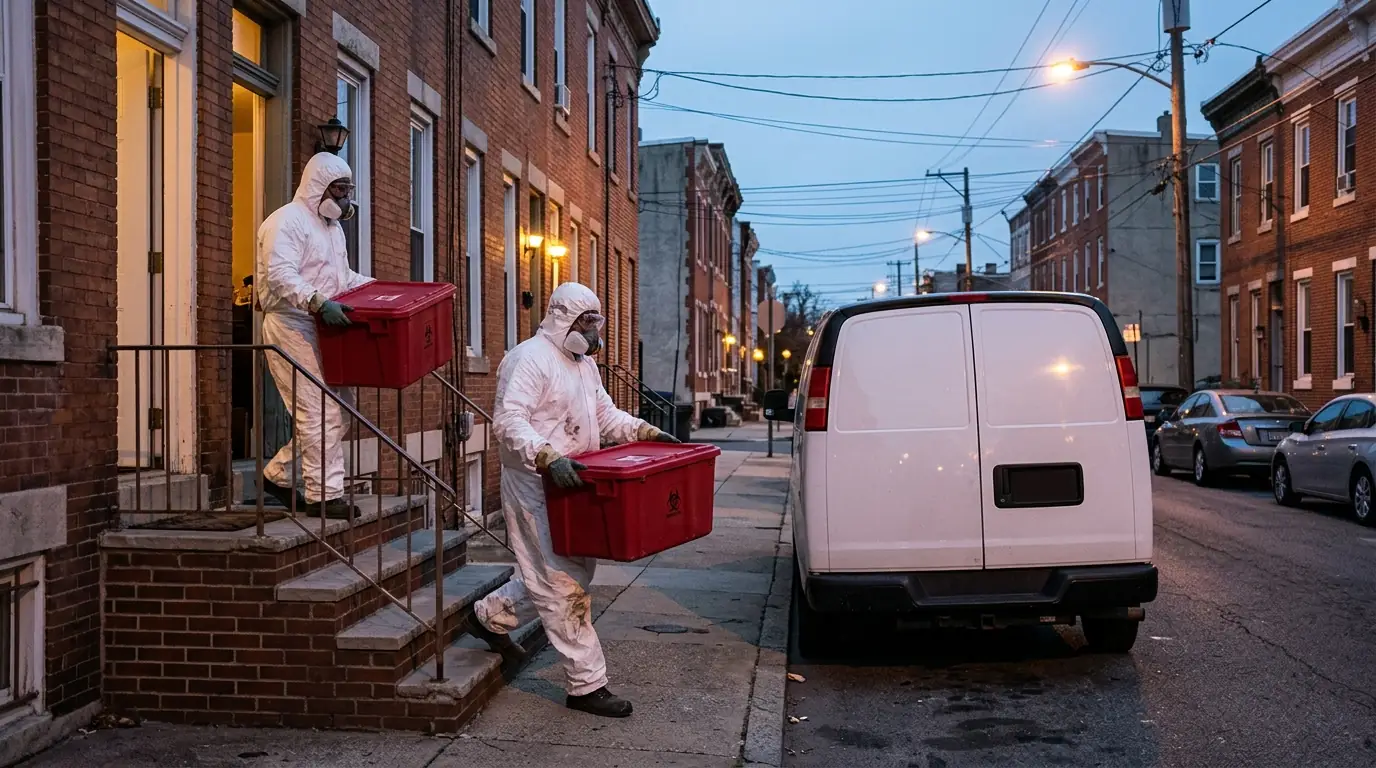
Discretion matters most in close quarters, and Philadelphia blocks are close. On a street of attached rowhomes, neighbors notice who comes and goes. We keep our presence low key: technicians put on protective suits inside whenever the layout allows, waste leaves in closed, sealed containers, and we don't talk about the job with anyone except the person who hired us.
We also follow your lead on contact. Some families want to be on site and walk the room with us at the end. Others prefer to drop off a key and not return until we call to say the work is finished. Either way, we take photographs only to document the job for insurance, and we share them only with you or your adjuster.
If you or someone in your family is struggling right now, please call or text 988 to reach the Suicide & Crisis Lifeline at any hour. Grief after a suicide can be heavy in ways people don't expect, and reaching out early helps.
Protecting personal belongings and keepsakes
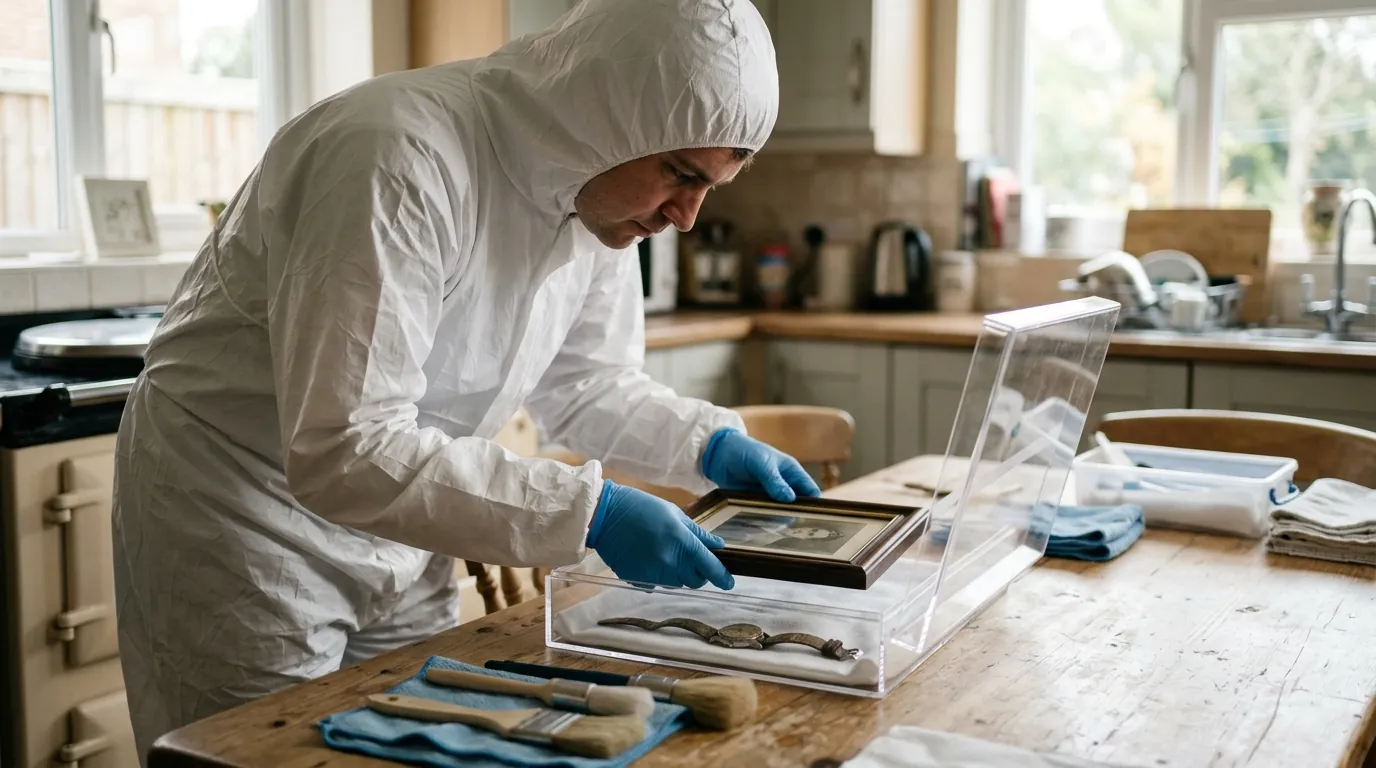
Rooms hold a person's life: a phone, a journal, a favorite sweater, letters, photographs. Before we remove any contaminated material, we look for these things and set them aside. Hard items like jewelry, watches and framed photos can often be cleaned and disinfected. Paper and fabric are harder, and when something can't be safely restored, we tell you before it's discarded.
If police or the Medical Examiner's Office asked you to look for certain items, or if there's something specific you're hoping to recover, tell us at the start. We'll search carefully and keep a short list of what we found and where. Everything we recover comes back to you in a sealed bag or box, cleaned and dry, at a time that suits you.
We never read through private papers beyond what's needed to protect them. Diaries and letters stay closed and go into your hands. Things you aren't ready to look at can be boxed and labeled, so the decision can wait for weeks or months.
Does homeowner's insurance cover suicide cleanup?
Often, yes. Many homeowner's and renter's policies treat cleanup after a death in the home as a covered loss, subject to your deductible and the policy's terms. Coverage varies between carriers and policies, so the only way to be sure is to ask. When you call your insurer, describe it as cleanup after a death at home, and ask whether biohazard remediation is included.
You don't have to handle the claim conversation alone. With your permission, we can speak directly with the adjuster, send a detailed scope of work with photographs and waste disposal records, and answer their questions. If the death happened in a rental property, the landlord's policy may be involved as well. Pennsylvania's VCAP program is designed for crime victims, so it usually doesn't apply here. If insurance won't cover the work, we'll talk through the cost openly before starting and explain each part of the bill in plain language.
What shapes the cost of suicide cleanup
We price each job after seeing it, and we'll walk you through the reasons before any work begins.
Size of the affected area
A small area on tile is simpler than one that reached carpet, walls and furniture.
Porous materials involved
Carpet, padding, mattresses, drywall and upholstery usually have to be removed rather than cleaned.
Time since the death
If some time passed before discovery, fluids and odor may have spread further into the structure.
Location in the home
Bathrooms, bedrooms, basements, garages and vehicles each call for different methods and equipment.
Waste volume and disposal
The amount of sealed waste sent to a permitted facility affects disposal costs.
Homeowner's and renter's insurance frequently covers this type of cleanup, and we can work directly with your carrier. We explain the bill in plain terms, and we never pressure families into quick decisions about belongings or rooms. If cost is a worry, tell us at the start so we can talk it through honestly.