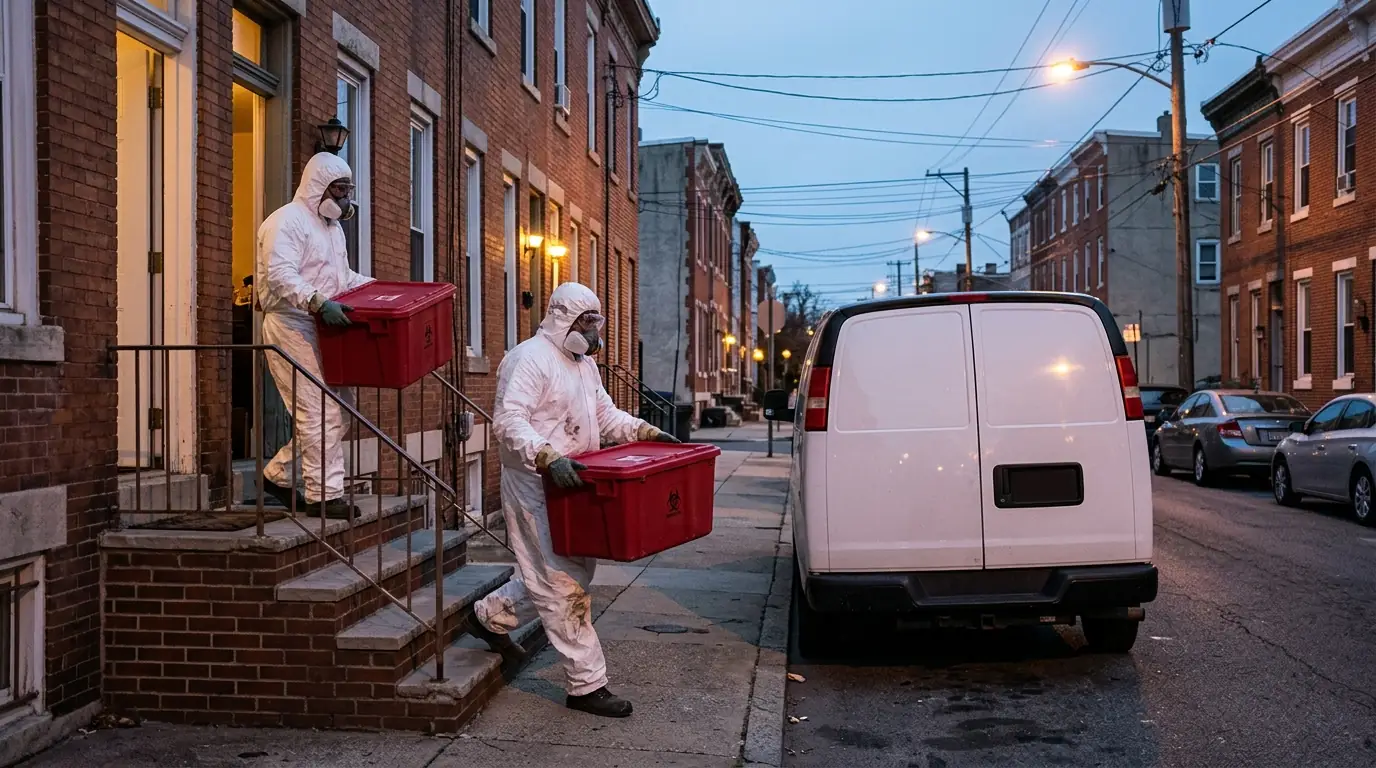
Most people never think about where biohazard waste goes until they're holding some. A landlord finds a box of used syringes in a vacated unit. A tattoo studio closes and has a cabinet of full sharps containers. A family finishes caring for a relative at home and has leftover dressings, lancets and soiled bedding. A small shop has a cleanup after an injury. In each case, the waste can't go out with Tuesday's trash, and the city's regular collection won't take it.
Our technicians handle these one-time jobs across Philadelphia and the nearby counties. Most of our disposal work comes straight out of our own cleanups, so the packaging and paperwork are routine for us. We don't run standing pickup routes for hospitals or large clinics, which have long-term medical waste contracts. We're built for the person or business that needs this done once, correctly, without signing up for a monthly service.
What counts as biohazard waste in Pennsylvania
Pennsylvania calls this category infectious waste, and the Department of Environmental Protection regulates how it is stored, moved and treated. In plain terms, it includes used sharps such as needles, syringes with needles attached, lancets and scalpel blades. It also includes items soaked or caked with blood or other potentially infectious body fluids, along with certain waste from treating people or animals for infections.
Plenty of waste from a cleanup is not infectious. A carpet with a small, dried stain may be handled differently from a mattress soaked through. Household trash, empty medicine bottles and most personal care items are not infectious waste at all. Sorting matters, because treating everything as biohazard raises cost while treating real infectious waste as trash puts sanitation workers at risk.
We make that call on site, following DEP guidance and OSHA's bloodborne pathogens standard. When we're not sure, we treat the material as infectious. That's the safer side to be on.
Red bags, rigid containers and sharps boxes
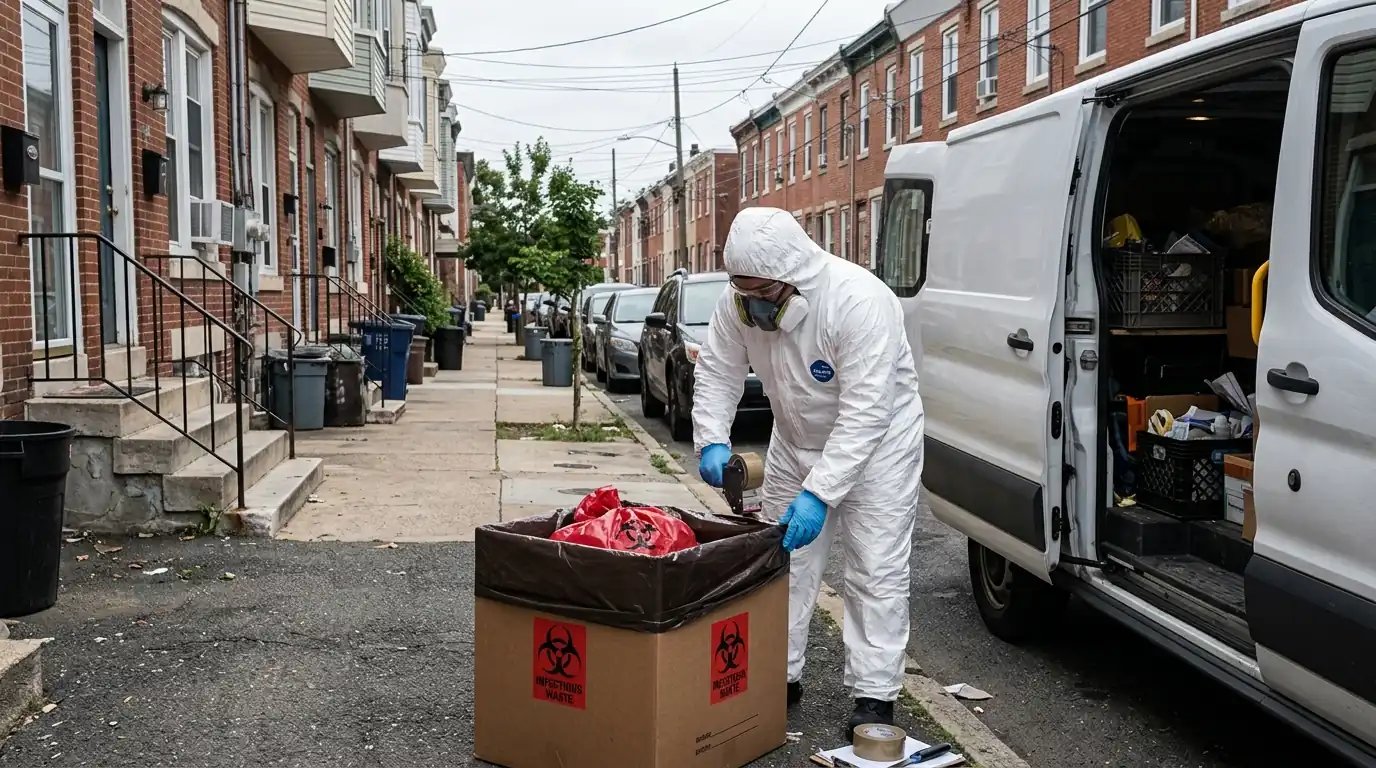
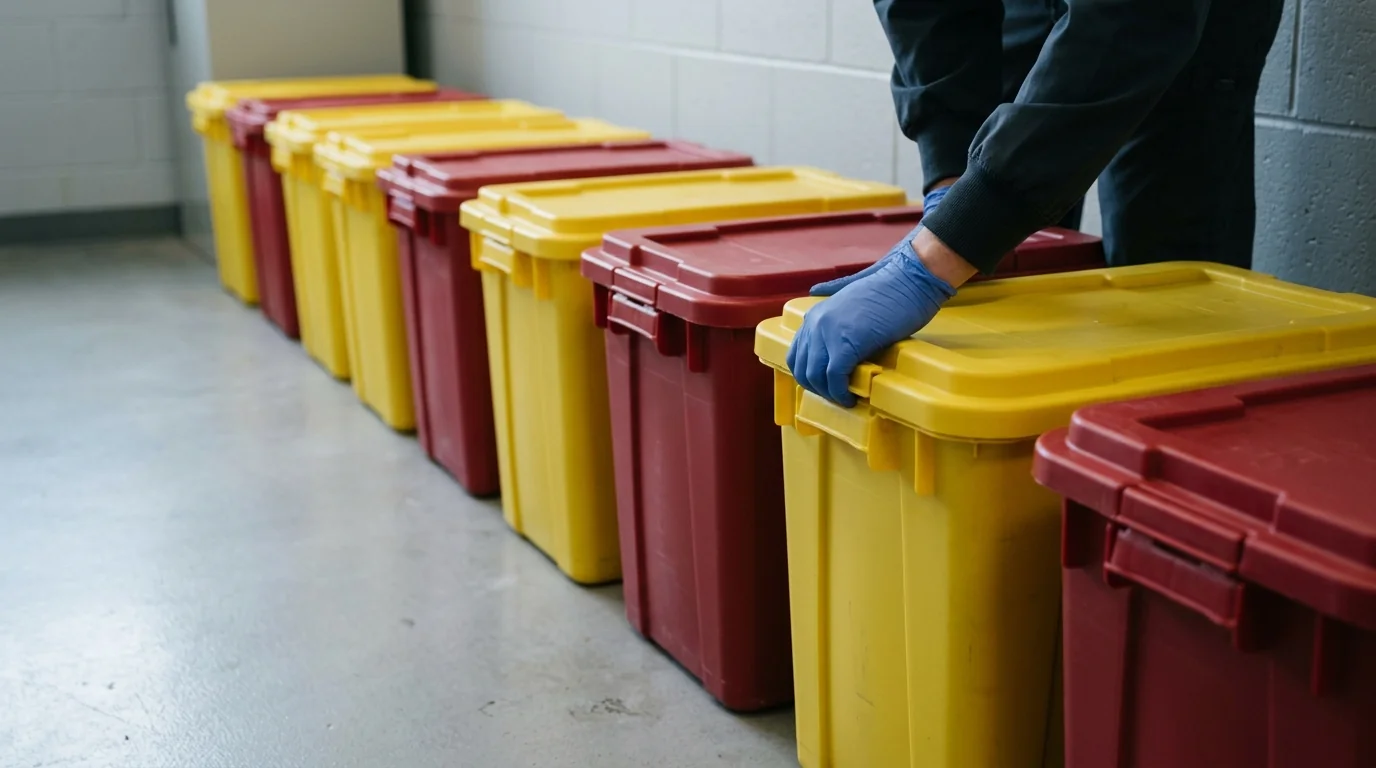
Packaging is where most of the risk is controlled. Soft infectious waste goes into red bags marked with the biohazard symbol. These are thicker than ordinary trash bags and are tied off so nothing can leak. The bags then go inside a rigid outer container, usually a lined corrugated box or a reusable plastic bin, which is sealed and labeled for transport.
Needles and other sharps never go into bags, where they could poke through and stick someone. They go into puncture-resistant, leak-resistant sharps containers with a closing lid. A container is closed and locked once it's about three quarters full, rather than packed to the top.
Federal Department of Transportation rules also govern how this waste is packaged and marked for the road, so the outer containers carry the right markings for regulated medical waste. Our technicians handle every piece in nitrile gloves and protective clothing, and sharps are picked up with tongs or grabbers rather than fingers.
- Red bags with the biohazard symbol for soft waste
- Rigid, lined outer containers sealed for transport
- Puncture-resistant sharps containers, closed before full
- Tongs and gloves for every needle we pick up
How we package and remove biohazard waste
Talk through what you have
On the call, we ask what the waste is, roughly how much, and where it is, so we bring the right containers.
Sort on site
Our technicians separate infectious waste and sharps from ordinary trash, which keeps the regulated load as small as it can be.
Package correctly
Soft waste goes in red bags inside rigid boxes, and sharps go into puncture-resistant containers that are closed and sealed.
Label and complete the manifest
Containers are marked for transport, and the manifest records the waste, the quantity and the receiving facility.
Clean and disinfect the area
Where waste sat, we clean and disinfect the surfaces so the space is safe to use again.
Send for treatment and document
The waste goes to a permitted treatment facility, and you receive documentation of the disposal.
Tracking paperwork and where the waste ends up
Infectious waste in Pennsylvania travels with a manifest, a tracking document that follows it from the place it was generated to the place it is treated. The paperwork records who generated the waste, how much there was, who carried it, and which facility received it. That chain matters if anyone later asks where the material went.
The waste goes to a facility permitted by the state to treat infectious waste. Most of it is treated in an autoclave, a large steam chamber that uses heat and pressure to kill germs, or by incineration. After treatment, the material is no longer infectious and can be disposed of as ordinary solid waste.
For you, the useful part is the record. When the job is done we can provide documentation showing the waste was packaged and sent for treatment. Landlords, property managers and small business owners often keep that with their files, and an insurer handling a cleanup claim may ask for it.
When you need biohazard waste disposal
Needles left in a rental unit
Used syringes found during a turnover or eviction need sharps containers and proper disposal, not a trash bag.
A home care period has ended
Dressings, lancets, soiled linens and other supplies from home medical care can include infectious waste.
A small business is closing
Tattoo studios, salons and similar businesses often have full sharps containers that need final disposal.
A cleanup produced soiled materials
Towels, rugs or furniture soaked with blood or bodily fluids should be packaged as infectious waste.
Waste was stored too long
Bags or boxes of medical waste left in a basement or closet should be repackaged and removed.
Your hauler refused the load
Regular trash haulers and dumpster companies won't accept infectious waste or loose sharps.
One-time disposal for homes, landlords and small businesses
Our disposal work fits people who don't generate this waste every week. Common examples around Philadelphia include landlords clearing needles and soiled bedding from a unit after an eviction, owners of rowhomes where someone used drugs in a basement, families finishing home hospice or wound care, and small businesses such as salons, tattoo studios or martial arts gyms that have a cleanup or are closing.
We also handle the waste from our other work, including blood cleanup, trauma scenes and needle sweeps, so the disposal is already built into those jobs. If you only need disposal, we come out, sort what's there, package it on site, and take it away.
Please don't try to drive this waste anywhere yourself or tuck needles into a soda bottle and put it in the trash. Philadelphia sanitation workers and recycling sorters get stuck by needles that end up in regular bins. If you have a few household sharps from insulin or other prescriptions, your pharmacy or the city can point you to collection options. For larger or mixed loads, call us.
What shapes the cost of biohazard waste disposal
Disposal is priced by what's there and how it has to be packaged. We give you the price before we load anything.
Volume of infectious waste
The number of boxes and bins needed is the biggest single driver.
Number of sharps
Loose needles take time to collect safely, and each sharps container adds to the load.
Sorting required
Mixed piles of trash, belongings and infectious material take longer to sort than prepackaged waste.
Access to the waste
A basement in a narrow rowhome or an upper floor without an elevator adds carrying time.
Cleaning of the area
Surfaces that held leaking bags or loose sharps need cleaning and disinfecting after removal.
When disposal is part of a covered cleanup, such as a sudden trauma event, homeowner's insurance often includes it in the claim. Stand-alone disposal for a business or landlord is usually billed directly. We'll give you the documentation an adjuster or accountant may want.