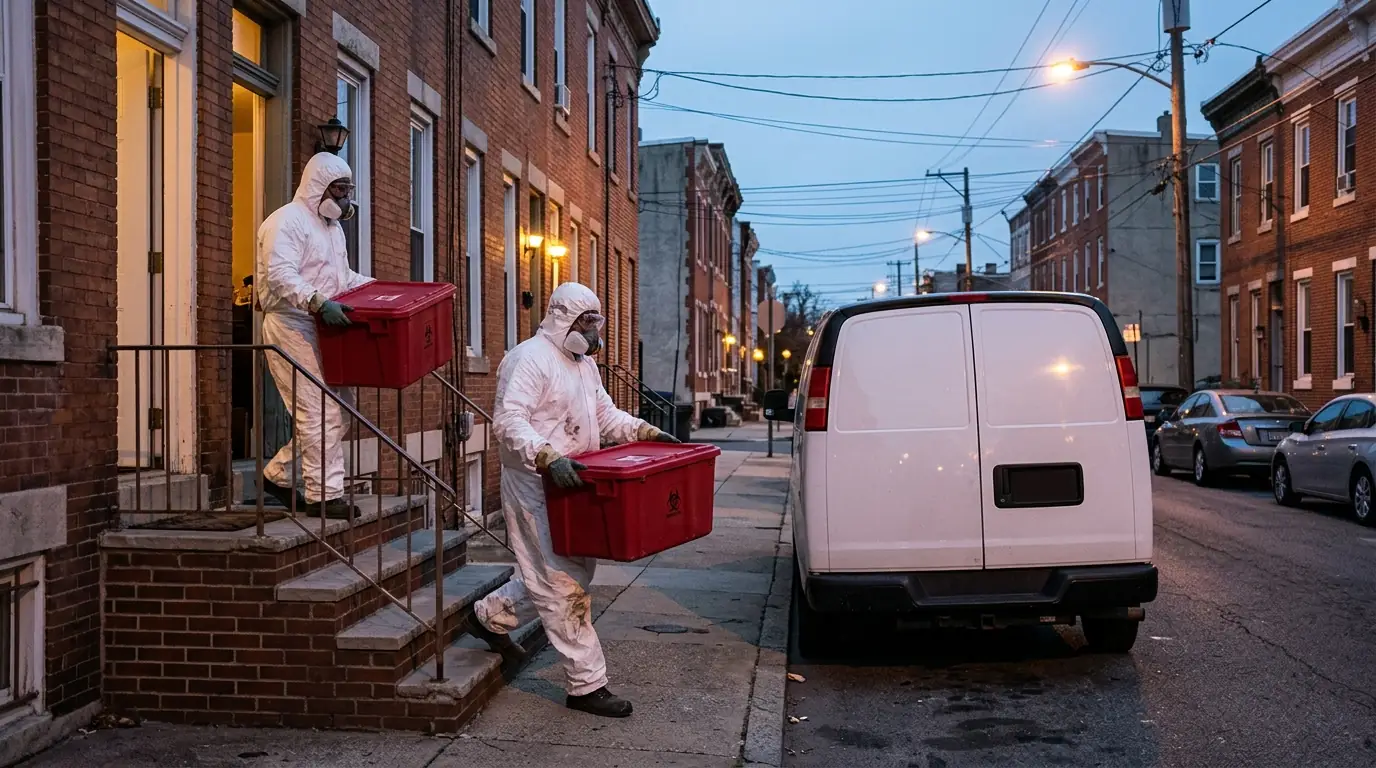
Homicide investigations in Philadelphia can keep a house closed for days. Detectives from the Homicide Unit and the crime scene unit work through every room that might hold evidence, and they leave when the case no longer needs the location. The family, estate or owner then receives a home that has been searched, dusted, swabbed and photographed, often with contamination in more than one room and no instructions about what to do next.
That's the starting point for our work. Unlike a single injury in one spot, homicide scenes tend to spread: a struggle that moved from a living room to a hallway, footprints tracked up stairs, or fluids carried on clothing and shoes. Add the residue investigators leave behind, and the job becomes as much about careful detail cleaning across the house as about removing the most obvious damage. We plan for all of it from the first walkthrough.
When to call us for homicide cleanup
Detectives have released the home
The investigation no longer needs the property, and you've been told you can go back in.
Several rooms were affected
Contamination or investigation residue reaches more than one room, a stairway or a vehicle.
Powder and chemical residue remain
Walls, glass and furniture are coated with fingerprint powder or film from reagents.
A rental unit needs restoring
A landlord needs the unit cleaned with discretion before repairs or a new tenant.
Media is watching the address
You need the work done quietly while reporters or onlookers are still around.
Family can't face going back
Relatives need someone to enter first, recover belongings and prepare the home.
Why homicide scenes often reach several rooms
Investigators photograph and map the path of what happened, and that path rarely stays in one place. Blood transfers easily. A person moving through a house, or emergency responders working to help, can carry it across floors, onto door frames, light switches and railings, and into bathrooms where someone tried to wash. Each of those spots is small, but together they can cover much of a home.
We handle this by mapping before we clean. During the walkthrough, we note every room that shows signs of contamination, then check the less obvious places: the underside of door handles, stair nosings, the grout around a sink, the inside of a closet door. In older Philadelphia homes with wood floors and plaster walls, we also check seams and cracks where small amounts can settle. Containment goes up around the heaviest areas first, and the rest of the house is cleaned in an order that keeps finished rooms from being recontaminated.
How we carry out a homicide cleanup
Confirm release and authority
We confirm the property has been released and who can authorize the work, then set a time that suits the family.
Map the whole house
A full walkthrough identifies every affected room, surface and hidden path, along with all powder and reagent residue.
Contain and remove
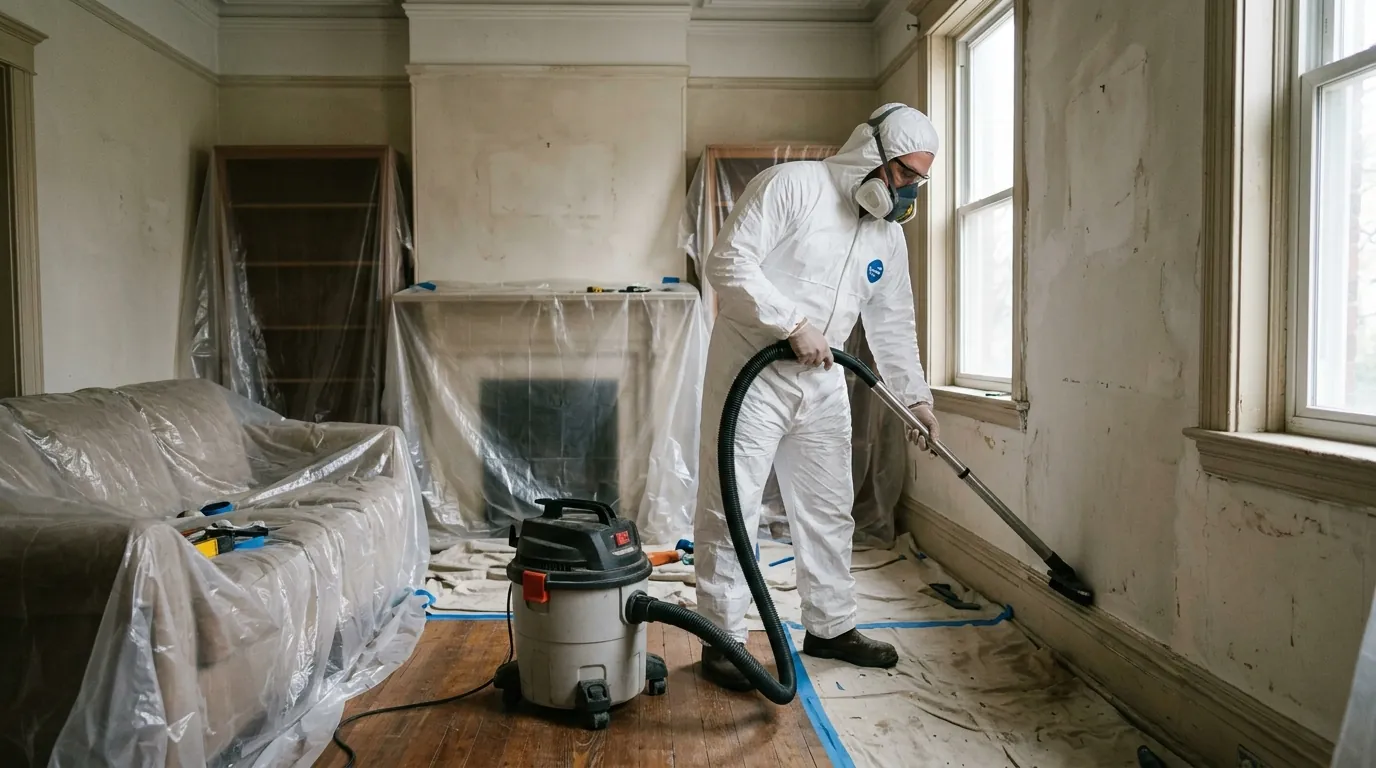
Heavily affected rooms are sealed with poly sheeting under HEPA filtration. Saturated materials are cut out and packed in red bags and rigid containers.
Detail clean investigation residue
Fingerprint powder, reagent film and tape adhesive come off surface by surface with HEPA vacuums and suitable cleaners.
Disinfect and test
All affected areas receive hospital-grade disinfectant for the full dwell time, and ATP swabs check high-touch and heavily affected surfaces.
Return the home
Waste goes to a permitted facility, and we walk the family or owner through each room with documentation in hand.
Removing fingerprint powder and luminol residue
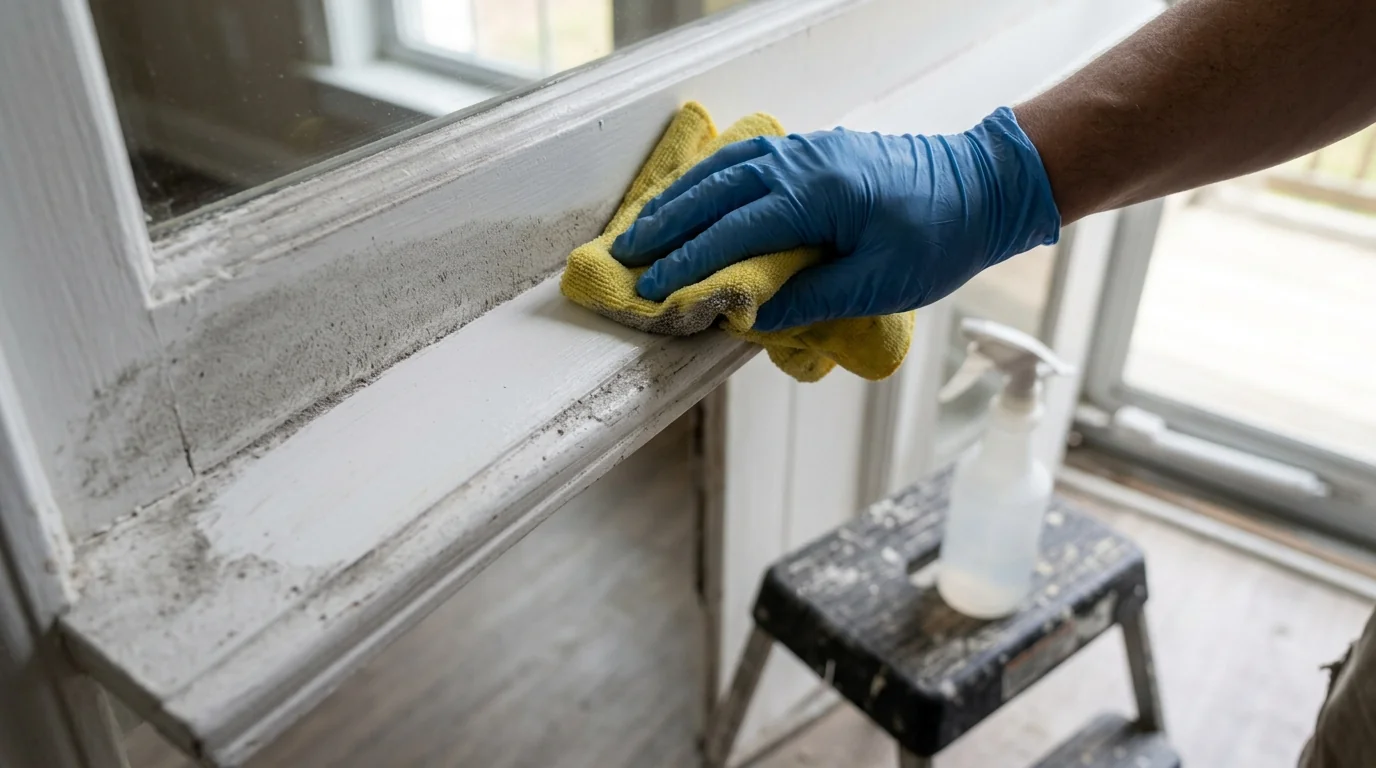
Fingerprint powder is extremely fine. Black, gray, white, magnetic and fluorescent powders are all common, and investigators may use several in one home. The powder clings to painted walls, glass, cabinets and furniture, and wiping it with a damp cloth usually just smears it into a larger stain. We start with HEPA vacuuming to lift loose particles, then use cleaning agents suited to each surface, working in small areas so the powder doesn't migrate into grout, fabric or wood grain.
Investigators may also use luminol or similar reagents to reveal traces of blood that aren't visible. These chemicals are sprayed as a fine mist and can leave a film on floors and walls. Where reagents were used, we treat the area as both chemically and biologically affected: we clean off the film, then disinfect, because the reason the chemical was used is that blood was present. Adhesive left by evidence tape and markers comes off at the same time, so painted surfaces are ready for touch-up.
Handling media attention while keeping your home private
Some homicides draw news crews and online attention for days. Reporters may knock on doors, photograph the house or film whoever comes and goes. Neighbors talk. For families already in shock, that attention can feel like a second intrusion. We can't control what the media does, but we can make sure our work adds nothing to the story.
We arrive without fanfare, keep equipment staging out of sight where the building allows, and avoid carrying anything out in a way that would make an upsetting photograph. Our technicians don't speak to reporters, neighbors or anyone else about the job. If someone asks, the answer is simply that we're there to help the family. We can also schedule work for early mornings or evenings when a block is quieter, and we'll check in with you before we arrive. Photos we take for insurance stay with you and your adjuster and never appear online.
Who can authorize homicide cleanup and what to have ready
The person with authority over the property signs off on the work. That's usually the homeowner, the next of kin acting for the estate, or, for rentals, the landlord. Sometimes the person with authority is also the one grieving most, and we try to keep their part short: a few questions, a signature, and a way to reach them.
A few things make the process easier if they're available. Confirmation from detectives that the scene is released, and the detective's name if you have it, can help if questions come up later. Your insurance policy number lets us start talking with the adjuster. A victim advocate, often from the District Attorney's Office, can explain how Pennsylvania's VCAP program may help eligible families with cleanup costs. None of these are needed before you call. We can start the conversation with nothing more than an address, and we'll gather the rest with you as the days go on.
What shapes the cost of homicide cleanup
Homicide cleanup is priced on scope, and scope depends on how much of the home the event and the investigation touched.
Number of rooms
Each room with contamination or residue adds containment, cleaning and testing time.
Depth of contamination
Fluids that reached subfloor, plaster or framing need removal, not just surface work.
Amount of investigation residue
Heavy powder use across walls and furniture can take as long to clean as the biohazard itself.
Furniture and contents
Upholstered pieces, mattresses and rugs that absorbed fluids are disposed of as biohazard waste.
Timing and discretion requests
Early morning, evening or staggered visits to avoid attention can affect scheduling.
Homeowner's insurance often covers cleanup after a violent crime at home, and VCAP may reimburse eligible families for costs insurance doesn't cover. We prepare itemized records, photographs and waste paperwork for both. You'll know how billing works before any work begins.